
THE BASICS OF VECTOR BIOIMPEDANCE ANALYSIS
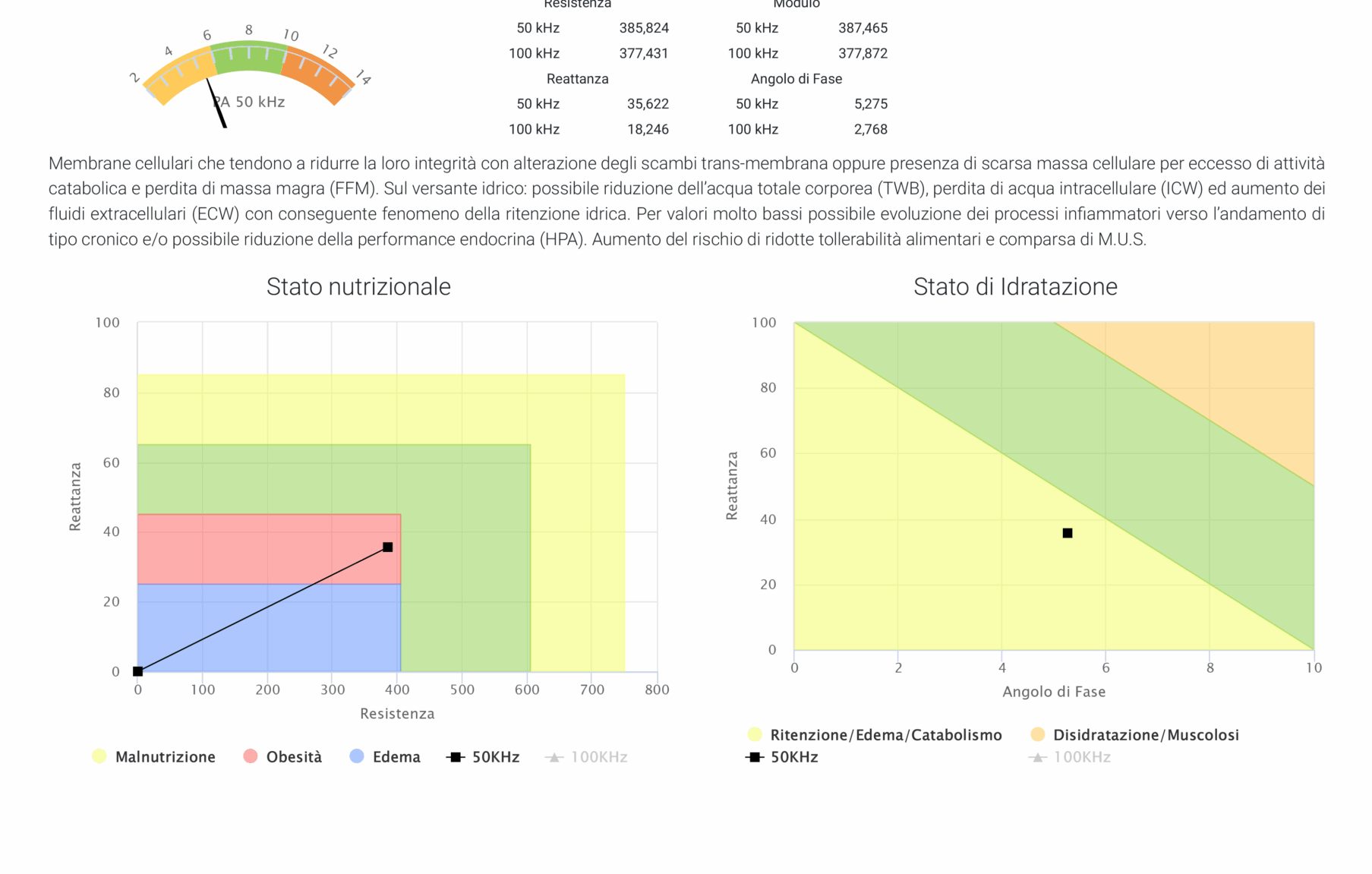
Vector bioimpedance analysis (BIA) is a non-invasive technique used to measure body composition by evaluating parameters such as impedance, resistance, reactance, and phase angle. Here is a detailed description of each value:
Impedance (Z)
Impedance is a measure of the total resistance that body tissue offers to the passage of an electric current. It is measured in ohms (Ω) and reflects the vector sum of resistance and reactance. It is influenced by the amount of water in the body and the distribution of intra- and extracellular fluids.
Resistance (R)
Resistance is the component of impedance that opposes the passage of direct current. It represents the difficulty with which electrolytes in body fluids (mainly water) allow the passage of electrical current. A greater amount of water and lean tissue (which contains more water) reduces resistance, while a greater amount of fatty tissue, which contains less water, increases resistance.
Reactance (Xc)
Reactance is the component of impedance that opposes the passage of alternating current and depends on the ability of cells to store and release electrical energy (capacitive behavior). It is mainly influenced by cell membranes and tissues. Higher reactance may indicate better cell membrane integrity and greater cell mass.
Phase angle (PA)
The phase angle is the tangent of the angle formed between resistance and reactance. It is measured in degrees (°) and can provide information about the quality of cell membranes and overall cell health. A higher phase angle generally indicates better cell integrity and function, while a lower phase angle may indicate cell stress, inflammation, or other pathological conditions.
• Impedance: High values may indicate dehydration or a high percentage of body fat, while low values may indicate good hydration and a higher amount of lean mass.
• Resistance: Low values are associated with good hydration and increased muscle mass, while high values may indicate dehydration or a high percentage of body fat.
• Reactance: High values are generally positive and indicate good cellular integrity and muscle mass, while low values may indicate reduced muscle mass or health problems.
• Phase angle: A high phase angle (e.g., >6°) is associated with good cellular health, while a low phase angle (e.g., <5°) may indicate health problems, inflammation, or other pathological conditions.
Vector BIA is a useful tool for assessing body composition and overall health, but it is important to interpret the results in a clinical context and in combination with other assessments and measurements. For accurate interpretation and to define personalized treatment plans, it is always advisable to consult a healthcare professional.
– Kyle, U. G., Bosaeus, I., De Lorenzo, A. D., Deurenberg, P., Elia, M., Gómez, J. M., … & Pichard, C. (2004). Bioelectrical impedance analysis—part I: review of principles and methods. Clinical nutrition, 23(5), 1226-1243. This article provides a comprehensive review of the principles and methods of bioimpedance analysis.
– Earthman, C. P., Traughber, D., Dobratz, J., & Howell, W. H. (2007). Bioimpedance spectroscopy for clinical assessment of fluid distribution and body cell mass. Nutrition in Clinical Practice, 22(4), 389-405. This study explores the use of bioimpedance spectroscopy for clinical assessment of fluid distribution and body cell mass.